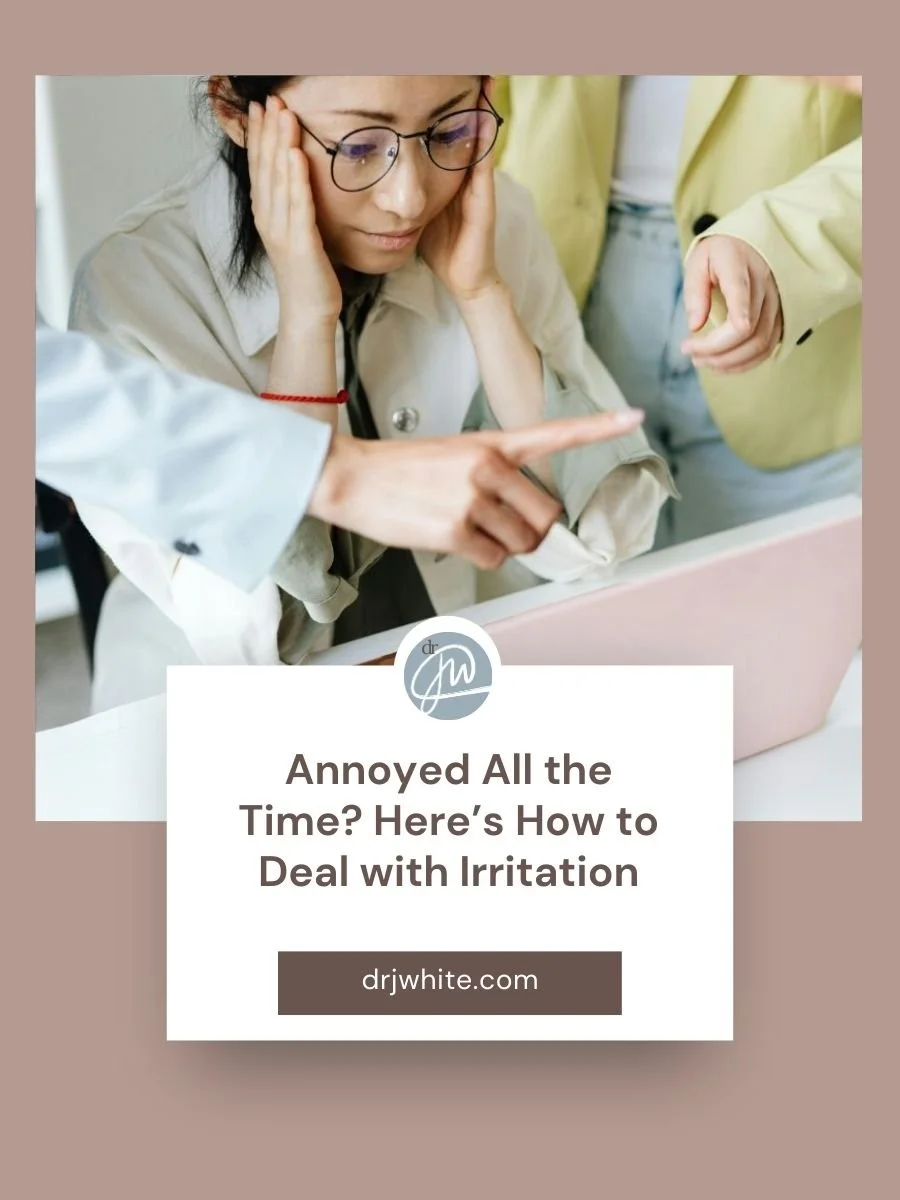

Annoyed All the Time? Here’s How to Deal with Irritation
⏱️ Estimated reading time: 5 minutes
Summary: You can’t avoid daily annoyances, but you can notice irritation sooner and respond differently using mindfulness, acceptance, defusion, and values-based choices. If you’re stuck in a cycle of snapping or spiraling, therapy can help you build steadier coping skills.

Introduction
Twice in the same morning, I came across unrelated media sources talking about the importance of letting go of small annoyances. It struck me because I had just returned from a trip abroad and, as anyone who has traveled knows, travel offers endless opportunities for small (and big) frustrations.
Surrounded by unfamiliar people, places, and routines, I was constantly practicing defusion (don’t worry, I’ll talk about this more below) from unhelpful thoughts. Again and again, it helped to take a breath, step back, sometimes literally, create a little space, and reassess what was happening.
Meet Dr. Jenny
Before we dive in, I’m Dr. Jenny, clinical psychologist who specializes in anxiety management for perfectionists and people-pleasers like you. As a person who practices these techniques in my own personal life, I here to remind you that you can silence your inner critic — you just may need some extra guidance. I’m here to help.
DISCLAIMER: I am a licensed clinical psychologist, and the information provided here is for general informational and educational purposes only. While I aim to share helpful and thoughtful content, reading this blog does not establish or imply a therapist-client relationship between us.
If you are experiencing a mental health crisis, please seek immediate help from a licensed professional or contact emergency services in your area. This blog should not be a substitute for professional mental health care or personalized guidance.
For personalized support or therapy services, please reach out directly to a licensed mental health provider in your area.
Table of Contents
- You’re Going to Get Annoyed
- Build Your Awareness
- Recognize early signs of irritation with Mindfulness
- Practice Mindful Breathing to Build Awareness
- What to Do Once You Notice the Annoyance
- Reconnect with what matters.
- Practice acceptance.
- Use defusion to create space.
- Choose Your Next Action
- Feeling an emotion doesn’t dictate how you must behave.
- Adjust what comes next
- Give yourself space.
- Suggested Reading:
You’re Going to Get Annoyed
Daily hassles are inevitable. Traffic, misplaced phones, alarms that mysteriously don’t go off, stubbing your toe, you name it. And amazingly, something that bothers you one day may barely register the next. That’s because our ability to tolerate frustrations depends on how “charged” we are. How full is your battery for handling setbacks? Are you rested, nourished, and feeling well? If not, even a small inconvenience can tip you into a full-blown meltdown. I’ve certainly been there, and I know you probably have too.
The key is noticing these moments and responding intentionally.
Build Your Awareness
Recognize early signs of irritation with Mindfulness
The first step is recognizing your early signs of irritation. Mindfulness is the skill I return to again and again because it strengthens that awareness. When you’re able to notice what’s happening before you’re overwhelmed, you have a chance to choose a different response.
You might notice tightness in your chest, tension in your shoulders, a clenched jaw, or holding your breath. Whatever your personal “tells” are, getting to know them gives you the power to respond intentionally rather than reactively.
Practice Mindful Breathing to Build Awareness
A regular mindfulness practice helps build this awareness. I won’t belabor the details here (I write about this often!), but a simple way to begin is with a few minutes of mindful breathing.
Find a quiet spot, set a timer for 3–5 minutes, and focus on where you feel your breath: in your chest, belly, nostrils, or the rise and fall of your shoulders. Gently return to the breath whenever your mind wanders (and it will wander). Counting up to ten on each inhale and exhale can help. Over time, your focus will naturally strengthen.
There are many ways to practice mindfulness. Headspace and Insight Timer are excellent options, and I love helping clients develop practices that work for them. Let me know if you’re ready to get started.
What to Do Once You Notice the Annoyance
Once you’ve noticed the annoyance, what next?
Reconnect with what matters.
This is where values work becomes essential (I have several posts on that). In the moment, it might feel catastrophic to wait a little longer for your coffee or run late to a meeting. But in the bigger picture, does it truly compromise what matters most to you? Usually, the answer is no.

Practice acceptance.
Acceptance doesn’t mean approval or liking something. It means seeing the situation for what it is without trying to control the uncontrollable. Ruminating about how things should be often just compounds your stress.
Use defusion to create space.

Defusion, another skill I write about often, helps you step back from unhelpful thoughts.
Sometimes physical space helps:
Take a brief walk
Excuse yourself to the restroom
Or simply pause for a few breaths
Mental space is just as useful. Try visualizing your thoughts as a tornado in the distance, or imagine yourself as the bus driver with your thoughts as noisy passengers but you’re still steering. Or picture your thoughts as a droning radio reporter whose volume you can turn down.
Whatever image works for you, the goal is to create distance so you can choose how to respond.
Choose Your Next Action
As I heard on The Lazy Genius Podcast this morning, host Kendra Adachi put it beautifully:
“You can be annoyed without being mean.”
Such a simple but powerful reminder. We often take our irritation out on whoever is nearby, even when they have nothing to do with it.
👂Here’s a link to the episode if you want to listen to it yourself: The Lazy Genius Podcast, #441 What to Do When Everything Is a Little Annoying
Feeling an emotion doesn’t dictate how you must behave.
You can be angry without yelling. You can be frustrated without snapping. Sometimes just naming the emotion provides relief.
Adjust what comes next.
You can also adjust what comes next. If you’ve hit your limit for the day, maybe tonight isn’t the night for a complicated meal, hit the easy button and get takeout. Maybe you take a walk at lunch instead of powering through your to-do list. If you push ahead while your frustration is simmering, you’re more likely to stack annoyances until everything feels unbearable.
Give yourself space.
Remember tomorrow is a new day. Annoyances are inevitable, but you can absolutely learn to work with them, not against them.
All of this is easier said than done. If you want support building awareness and curbing those reactivity impulses, I’m here and ready to help.